


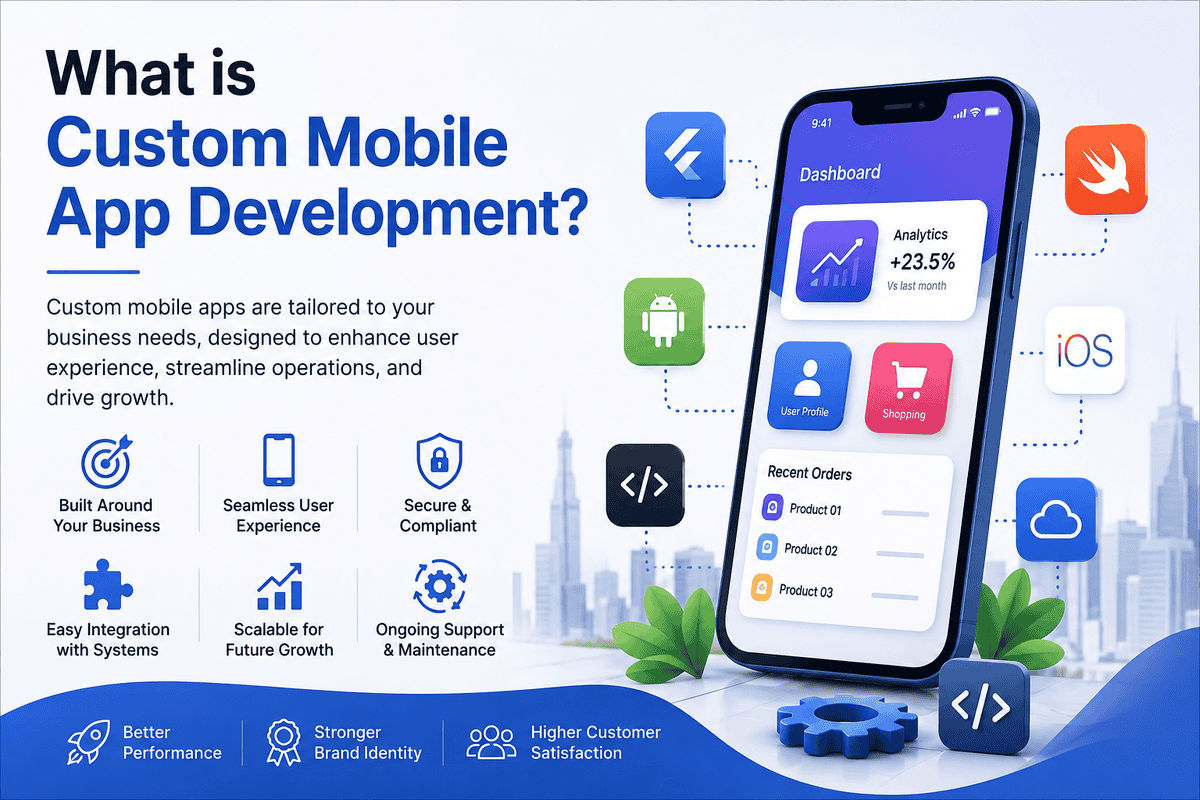
What Is Custom Mobile App Development? A Complete Guide
- Zygobit Solution
- Technology
- 2026-08-10 17:40:22
- 2238K
Mobile applications have become an important part of how businesses connect with customers, manage operations, and deliver digital services. While ready-made applications can be useful for common business needs, they often become limiting when a company has unique workflows, specific customer requirements, or complex integrations.
This is where custom mobile app development comes in.
A custom mobile application is designed and developed specifically around a business's goals, processes, users, and brand. Instead of changing your workflow to fit an existing application, custom development allows the software to be built around the way your business operates.
In this guide, we'll explain what custom mobile app development means, explore the different development approaches, walk through the development process, discuss costs, and explain how to choose the right development partner.
Key Takeaways
- Custom mobile apps are designed around specific business processes, users, branding, and requirements.
- Native, cross-platform, hybrid, and progressive web applications offer different advantages depending on project requirements.
- Development costs can range from tens of thousands to several hundred thousand dollars depending on complexity.
- A structured development process can reduce risks and make future scaling easier.
- Fixed-price and milestone-based development models can provide greater cost and scope predictability.
What Is Custom Mobile App Development?
Custom mobile app development is the process of designing and building a mobile application specifically for a particular business, product, or audience.
Unlike off-the-shelf applications, which provide a predefined set of features, custom applications are created according to specific requirements. This can include the user interface, functionality, integrations, security requirements, business workflows, and future scalability.
For example, a company may need an application that connects its CRM, payment system, internal database, and customer portal. A standard application may not provide the required integrations, while a custom solution can be developed specifically to connect these systems.
Custom Apps vs. Off-the-Shelf Apps
Off-the-shelf applications are attractive because they can usually be configured and deployed quickly. They also tend to have lower initial costs.
However, businesses may eventually encounter limitations such as:
- Generic features that don't match specialized workflows
- Limited customization options
- Restrictions on integrations
- Security and scalability limitations
- Recurring licensing costs
- Dependence on the vendor's product roadmap
Custom applications generally require more time and investment during development. However, businesses gain greater control over the application's features, integrations, user experience, and future development.
With a custom solution, the application can evolve as the business grows instead of being restricted by the capabilities of a third-party platform.
Why Do Businesses Choose Custom Mobile App Development?
Businesses typically consider custom development when existing applications cannot effectively support their processes or long-term goals.
1. Better Branding and User Experience
A custom application can be designed around the company's brand identity and the expectations of its target users.
Businesses can control the interface, navigation, features, and overall user experience instead of relying on a standard template.
2. Deeper System Integrations
Many businesses rely on multiple systems, including CRMs, ERPs, payment platforms, analytics tools, and internal APIs.
Custom applications can be designed with these integrations in mind from the beginning. This allows different systems to communicate more effectively and reduces the need for complicated workarounds.
3. Security and Compliance
Security and compliance requirements should be considered during the early stages of application development.
For businesses handling sensitive information, requirements such as GDPR compliance, consent management, data minimization, authentication, and audit trails can be incorporated into the application's architecture.
Custom development makes it possible to design these requirements into the product instead of attempting to add them after development is complete.
It's important to note that there is no universal statistic proving that custom applications always provide better ROI than off-the-shelf software. The value depends on the business, application, users, and specific requirements.
However, companies with specialized workflows or complex compliance requirements may find that generic software becomes restrictive as they grow.
Types of Custom Mobile Apps: Choosing the Right Development Approach
Custom mobile development doesn't mean using one specific technology. Businesses can choose from several development approaches depending on their performance requirements, budget, target platforms, and application functionality.
Native Mobile Apps
Native applications are developed specifically for a particular operating system.
For iOS, developers commonly use Swift, while Android applications are typically developed using Kotlin.
Native development provides direct access to device capabilities such as:
- Camera
- GPS
- Biometrics
- Sensors
- Bluetooth
- Other device-specific functionality
Native applications can also provide excellent performance and a highly optimized user experience.
The main disadvantage is that separate development may be required for iOS and Android. Maintaining two codebases can increase development and maintenance costs.
Cross-Platform Mobile Apps
Cross-platform frameworks allow developers to build applications for multiple platforms using a shared codebase.
Popular technologies include Flutter and React Native.
Flutter allows developers to create applications for iOS and Android from a shared codebase, while React Native uses native components to deliver a mobile experience.
For many business applications, cross-platform development can reduce duplicated development work and make it easier to maintain feature parity between platforms.
According to the GoodFirms study referenced in the original article, cross-platform development can reduce initial development costs compared with building separate native applications for each platform.
For applications based primarily on forms, dashboards, APIs, business workflows, and standard mobile features, cross-platform development can be a practical option.
Hybrid Mobile Apps
Hybrid applications combine web technologies such as HTML, CSS, and JavaScript with a native application container.
They can be quicker and less expensive to develop than some fully native solutions. However, complex applications may experience performance limitations depending on their functionality and implementation.
Hybrid development can be appropriate when speed and development cost are important considerations.
Progressive Web Apps
Progressive Web Apps, or PWAs, are applications that run through a web browser while providing many app-like capabilities.
One advantage is that users don't necessarily need to download an application through an app store. PWAs can also support certain offline capabilities.
However, access to native device features can be more limited than with native mobile applications.
Native or Cross-Platform: Which Should You Choose?
The right approach depends on the application's requirements.
If the application heavily depends on features such as advanced camera functionality, augmented reality, Bluetooth, or newly introduced operating-system capabilities, native development may be the better choice.
For applications primarily involving forms, dashboards, lists, APIs, and standard business workflows, cross-platform development can provide a balance between functionality, development time, and cost.
The Custom Mobile App Development Process
A successful custom application requires more than simply writing code. A structured development process helps turn an initial idea into a functional and scalable product.
1. Discovery and Requirements Analysis
The first stage is understanding the business, its objectives, target users, and the problem the application needs to solve.
During discovery, the development team can identify important features, technical requirements, integrations, potential challenges, and the scope of the project.
This stage helps ensure that development efforts are focused on solving a real business or customer problem.
2. Planning, UX/UI Design, and Prototyping
Once the requirements are understood, the project moves into planning and design.
Developers and designers determine the technology stack, create wireframes, define the application's structure, and establish the initial MVP scope.
Prototypes can also be tested before development begins. Finding usability problems at this stage is generally easier and less expensive than fixing them after the application has been developed.
3. Development and Coding
During development, the front end and back end are built according to the approved requirements and designs.
APIs and third-party integrations can be implemented as part of the development process.
Many teams use Agile development practices and work through smaller development cycles or sprints. Regular reviews make it easier to identify problems and adjust requirements before the project reaches its final stages.
4. Testing and Quality Assurance
Testing is a critical part of custom mobile app development.
Applications should be tested across multiple areas, including:
Functional Testing
Functional testing checks whether individual features work according to the defined requirements.
Performance Testing
Performance testing evaluates how the application behaves under different usage conditions and loads.
Security Testing
Security testing helps identify vulnerabilities in authentication, data handling, APIs, and other parts of the application.
Device and OS Compatibility Testing
The application should be tested across relevant devices, screen sizes, and operating-system versions to ensure a consistent experience.
5. Deployment and Launch
After testing is complete, the application can be prepared for release.
Publishing an application through Apple's App Store or Google Play involves following platform-specific requirements and guidelines.
A staged release or limited rollout can also help identify unexpected issues before the application becomes available to the entire user base.
6. Post-Launch Support and Maintenance
Launching an application is not the end of development.
Mobile operating systems, devices, security requirements, and user expectations continue to change. Applications therefore require ongoing maintenance, security updates, bug fixes, and improvements.
Regular maintenance can also help ensure that an application remains compatible with newer operating-system versions and continues to provide a reliable user experience.
How Much Does Custom Mobile App Development Cost?
There is no single price for custom mobile app development. The total cost depends on the application's complexity, functionality, platforms, integrations, development team, and long-term requirements.
Some of the most important factors include:
Feature Complexity
A basic application with a few screens and standard functionality will generally cost less than an application requiring real-time synchronization, AI functionality, offline capabilities, advanced security, or complex workflows.
Number of Platforms
Developing for a single platform can require less work than supporting both iOS and Android.
However, cross-platform development can help reduce duplicated development work depending on the project.
Development Team Location
Development rates can vary significantly depending on where the development team is located.
Integrations and Compliance
Integrating CRMs, ERPs, payment systems, internal APIs, analytics platforms, and other third-party services can increase development effort.
Similarly, applications that require specific security or regulatory requirements may need additional architecture, testing, and documentation.
Typical Custom App Development Cost
The GoodFirms benchmarking information referenced in the original article provides several broad project ranges.
A basic or small application may cost approximately $15,000 to $40,000 and may take around 3 to 6 months to develop.
A mid-level application may cost approximately $40,000 to $120,000, with development taking around 6 to 9 months.
Advanced applications can cost approximately $100,000 to $250,000 or more and may require around 9 to 12 months.
Enterprise-level applications can exceed $250,000, with some projects reaching $500,000 or more and taking 12 to 18 months or longer.
These figures are global benchmarks rather than fixed prices for a particular business or region. Actual project costs can vary considerably based on requirements.
What Does an App With 10,000 Users Cost to Maintain?
The number of users alone doesn't determine the value or cost of an application.
As the user base grows, businesses may need additional infrastructure, monitoring, support, security improvements, and performance optimization.
The GoodFirms information referenced in the original article estimates annual maintenance and support at approximately 15% to 25% of the overall software budget.
For this reason, maintenance and support should be considered part of the long-term application budget rather than an expense that begins only after launch.
Why Fixed-Price, Milestone-Based Development Can Help
Software projects can experience scope creep when requirements aren't clearly defined.
A seemingly small request can sometimes introduce additional development, testing, and design work.
A fixed-price, milestone-based approach can help provide greater predictability by:
- Defining the project scope before development begins
- Connecting payments to agreed milestones
- Reviewing completed work at each stage
- Getting client approval before moving to the next phase
This approach can make it easier for businesses to manage budgets and track project progress.
How to Choose the Right Mobile App Development Partner
Choosing the right development company is an important decision because the quality of the development process can affect the application's performance, security, scalability, and long-term maintenance.
Before contacting development companies, clarify three things:
- The application's essential features
- Long-term scalability requirements
- Available project budget
A clear project brief makes it easier for development teams to provide realistic estimates.
When comparing potential development partners, consider the following factors.
Technical Expertise
Find out whether the development team has experience with the technologies required for your project.
Depending on your needs, this could include Swift, Kotlin, Flutter, React Native, backend technologies, APIs, cloud platforms, databases, and other technologies.
Portfolio and Previous Projects
Review the company's previous work and look for projects that demonstrate experience with similar technical or industry requirements.
A strong portfolio can provide insight into the team's design quality, technical capabilities, and experience delivering production applications.
Client References
Previous client feedback can provide additional information about communication, project management, technical delivery, and post-launch support.
Transparent Pricing
Look for development partners that clearly explain what is included in the project scope, how milestones work, and what could result in additional costs.
A transparent pricing structure can reduce misunderstandings later in the project.
Post-Launch Support
Ask what happens after the application goes live.
Important questions include:
- How long is the initial support period?
- How are bugs handled after launch?
- What happens when the support period ends?
- Is ongoing support optional or mandatory?
- Are there any long-term contracts or lock-in clauses?
Security and Compliance
If your application handles sensitive customer or business information, discuss security and compliance before signing a development agreement.
Security should be considered during architecture and development rather than added as an afterthought.
Frequently Asked Questions
How Much Does Custom Mobile App Development Cost?
The cost depends on the application's complexity, platform requirements, integrations, development team, and security requirements. Broad industry benchmarks can range from around $15,000 for basic applications to $500,000 or more for enterprise-level projects.
How Much Is a Custom Mobile App With 10,000 Users Worth?
There is no fixed value based solely on the number of users. The application's value depends on revenue potential, infrastructure requirements, maintenance costs, customer engagement, and business objectives.
Businesses should also plan for ongoing maintenance, which may represent approximately 15% to 25% of the original software budget annually, based on the benchmarking information referenced in the original article.
What Is the Difference Between Custom and Off-the-Shelf Mobile Apps?
Custom applications are built specifically around a business's requirements and provide greater control over features, integrations, branding, and future development.
Off-the-shelf applications are generally faster and less expensive to deploy but provide less flexibility and customization.
Should I Choose Native or Cross-Platform Development?
Native development may be preferable when an application depends heavily on advanced device features such as camera functionality, AR, Bluetooth, or specialized hardware.
Cross-platform development can be suitable for standard business applications involving forms, dashboards, APIs, and common mobile workflows.
How Long Does It Take to Build a Custom Mobile App?
Development time depends on the project's scope and complexity.
Basic applications may take around 3 to 6 months, mid-level applications may require 6 to 9 months, while advanced or enterprise applications can take 9 to 18 months or longer.
What Happens After a Custom Mobile App Is Launched?
Post-launch work can include bug fixes, security updates, performance improvements, operating-system compatibility updates, and new features.
Businesses should establish a maintenance and support plan to ensure the application remains reliable as technology and user requirements change.
Final Thoughts
Custom mobile app development gives businesses the flexibility to build software around their specific requirements instead of adapting their operations to a generic application.
From the initial discovery stage through design, development, testing, deployment, and ongoing maintenance, every stage plays an important role in creating a reliable mobile product.
The right development approach depends on your application's functionality, target audience, budget, platform requirements, integrations, and long-term goals.
Whether you choose native, cross-platform, hybrid, or PWA development, defining your requirements clearly and working with an experienced development partner can help create an application that is easier to scale, maintain, and improve over time.
2238 people like this


About Zygobit Solution
Zygobit is a web and mobile app development company delivering scalable digital solutions and agentic AI services to clients USA and worldwide. The company specializes in building high-performance applications for startups, enterprises, and growing businesses across diverse industries. Zygobit offers custom mobile app development services for iOS and Android, along with tailored web development solutions. Their UI/UX design services focus on creating intuitive and engaging user experiences that drive conversions. The company also provides SEO, digital marketing, and agentic AI services to help businesses improve online visibility, automate workflows, and generate quality leads. In addition, Zygobit works with advanced technologies such as AI, machine learning, and blockchain to develop modern, efficient, and future-ready applications. Zygobit is committed to delivering reliable, scalable, and AI-driven solutions for clients USA and globally.
Leave a Reply
Please login to post a comment.







0 Comments